Diversify with private credit and equity real estate investment funds that make non-concessionary impact investments to expand access for America’s working families to affordable, safe communities.
Senior Secured Mortgage Fund that makes private credit investments to experienced real estate sponsors. Targets monthly passive income and annual returns of up to 10% for accredited investors.
Private Real Estate Investment Fund that invests in income-producing, attainable rental communities. Targets monthly passive income and annual returns of up to 12% for accredited investors.
Private Preferred Credit Fund that provides mezzanine loans and other subordinate financing to developers focused on attainable rental housing. Targets monthly passive income and annual returns of up to 11% for accredited investors.
Private Real Estate Investment Fund that invests in all stages of development to build, improve, and manage attainable rental housing. Targets monthly passive income and annual returns of up to 16% for accredited investors.
Private Real Estate Investment Fund focused on manufactured housing and RV-zoned communities, including vacation rental resorts and hospitality-integrated developments. Invests in the sale of manufactured homes and park models paired with land-lease structures. Targets long-term equity growth with a preferred annual return of approximately 10% for accredited investors.
Structured Private Note Offering providing priority credit exposure to DLP-managed real estate assets through secured Series B Notes. Designed to deliver fixed, predictable income with an 8% annual interest rate, monthly reporting, and a 5-year term for disciplined accredited investors.
See how DLP Capital’s lending fuels real estate projects that transform communities. These stories highlight the creativity, determination, and results of the talented sponsors we work with.
Explore a selection of our recent transactions across lending, acquisitions, and investments — demonstrating our commitment to delivering momentum, certainty, and impact for real estate projects nationwide.
Great outcomes come from consistent progress, not occasional sprints. That's the heart of our Twenty Mile March core value: setting clear goals, pursuing them with unwavering focus, and course correcting as needed. The Twenty brings that same discipline to your learning. Explore our latest webinars, articles, podcast episodes, and more.
Read the latest DLP Capital quarterly report for the most recent performance of DLP Capital-sponsored funds, updates on current investments within the funds, stories of our impact in action, company insights, and more.
CEO Don Wenner has built a life—and a company—dedicated to transforming lives through access to safe and attainable housing. Today, DLP Capital is creating solutions to the affordable housing crisis, redefining community, and helping investors discover success with significance.
DLP Capital’s purpose-driven, non-concessionary impact investments create housing, jobs, connection, and opportunity for families across America. Discover more about how DLP invests with purpose.
Meet the visionary leaders committed to executing DLP’s vision of transforming the lives of both residents and investors through the building of Thriving Communities.
Stay inspired by the latest updates from DLP Capital. Explore how we’re driving meaningful change, earning recognition, and celebrating milestones as we continue building thriving communities across America.
At DLP Capital, work is more than a job—it’s a mission. Join a team dedicated to solving America’s housing crisis, building thriving communities, and creating opportunities for families across the country.
Our mission starts with connection. Reach out to our team or visit one of our locations to learn more about how DLP Capital is creating impact where it matters most.
Private Real Estate Credit Could Offer Stability Amid Broader Asset Class Stress
Real estate-backed loans could have advantages over corporate private credit
August 14, 2026
Market Updates
Growing concerns surrounding loans extended to software companies facing disruption are causing investors to sour on corporate private credit. But real estate-backed loans secured by tangible assets could provide protection unavailable to private corporate lenders.
Since then, private credit assets under management (AUM) have ballooned exponentially. What was essentially a cottage industry 20 years ago is now an asset class with $3.5 trillion in AUM. During that timeframe, activity simultaneously broadened from corporate lending to encompass real estate, infrastructure, and other asset-backed loans.
Schedule a meeting with the DLP Investor Success Team.
However, private credit has faced growing pains. In February 2026, one leading private credit firm sold off $1.4 billion in loans extended to technology companies at slightly under par to satisfy redemption requests, a sign of waning investor confidence.
Investors appear largely concerned with the deteriorating credit quality of mid-sized software companies. These firms typically earn recurring revenues from software-as-a-service (SaaS) subscriptions, which were historically seen as one of the most dependable forms of revenue. Now, agentic coding assistants are threatening to upend these once-lucrative business models, leading to fears that software businesses may struggle to make their lenders whole.
These apprehensions are not unreasonable. In June 2026, one of the world’s largest private equity firms lost its $5 billion equity stake in an enterprise experience management platform after lenders seized control of the portfolio company following one of the largest restructuring processes in private credit history.
Real Estate Credit: A Pocket of Calm Within the Storm
In spite of the calamity of the broader corporate private credit market, loans backed by tangible assets, such as real estate, could offer greater security to lenders and their investors.
There are several reasons for this:
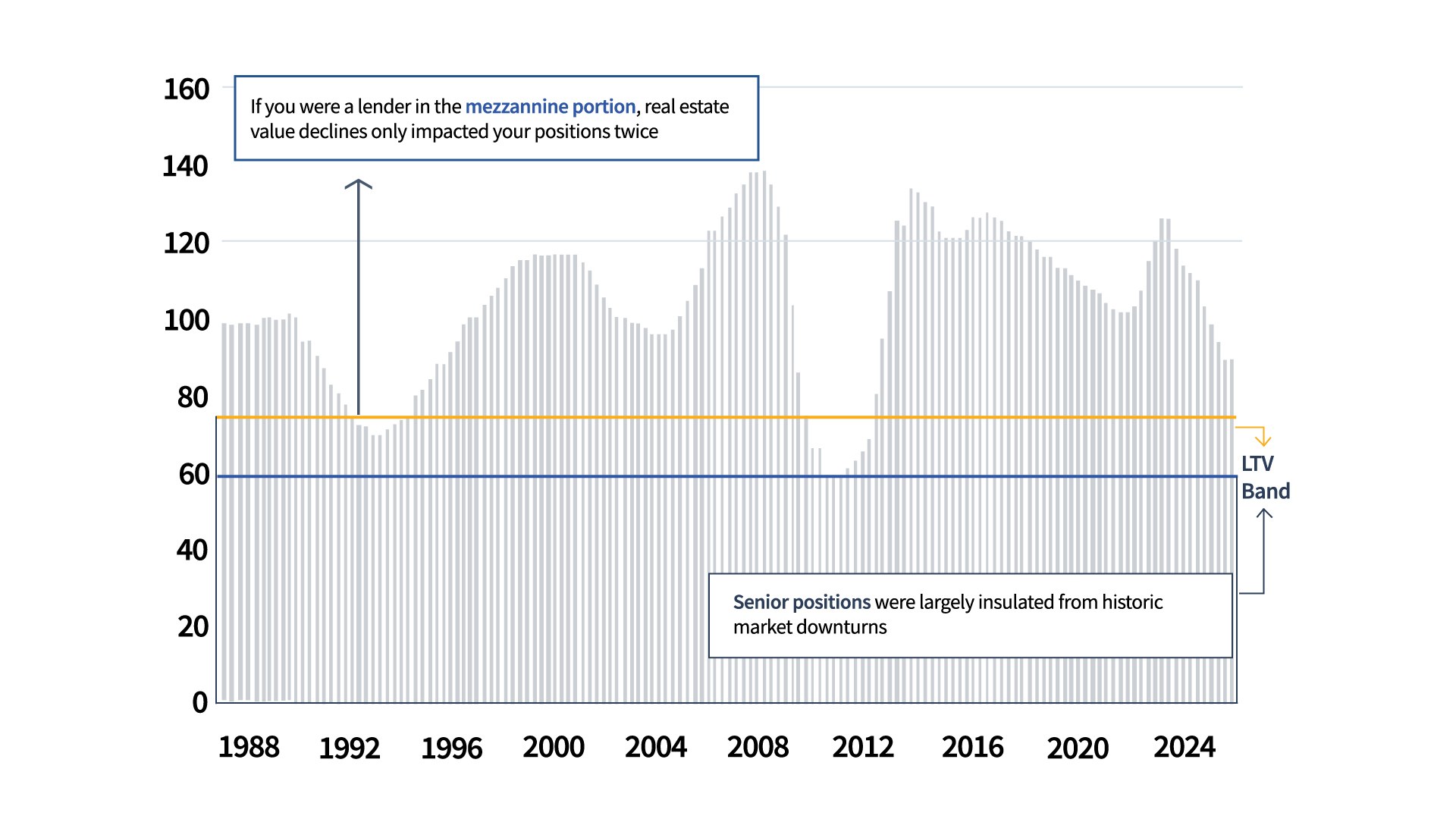
Unlike corporate private credit, real estate private credit is collateralized by physical assets. Because these assets can be foreclosed upon, real estate private credit lenders have recourse in a downside scenario.
Indeed, real estate loans originated at the bottom of the capital stack have been virtually insulated from even the most severe property market downturns, including the aftermath of the 2008 Global Financial Crisis.*
This characteristic is largely unique to real estate debt and stands in sharp contrast to corporate loans, which are more exposed to borrower operating performance and simultaneously less well collateralized.
Private real estate loans typically have maturities of 1 to 3 years, which are shorter than the 5- to 7-year maturities common for corporate private debt. Shorter maturities increase loan turnover and origination fees while minimizing market, duration, operating, and valuation risk.
For these reasons, charge-off rates for real estate debt are historically about 0.50% to 1.00% lower than those of commercial loans,* depending on the period measured.
Clearly, this is not to suggest that real estate private credit is invulnerable to the vicissitudes of the market. But it does mean that real estate loans could provide greater security relative to the beleaguered corporate loans making headlines today.
Our website uses cookies to enhance your experience, analyze website traffic, and deliver content tailored to your interests. By clicking "Accept", you consent to our use of cookies.