




Many private alternative investments, like real estate funds, are only available to accredited investors. Here’s what that means.
Publicly traded instruments, such as stocks, bonds, and exchange-traded real estate investment trusts (REITs), are so termed because any member of the public with a brokerage account can invest for as little as the price of one share. The criteria for accredited investor status in certain offerings were established to ensure that all participating investors possess financial sophistication and are capable of independently managing or bearing the risk of loss.
While accessible, public investments only represent a small fraction of the investable universe. This means that investors who allocate exclusively to publicly traded assets risk limiting their portfolio’s diversification potential.
Consider the numbers: according to Vanguard, over 85% of the 21,000 U.S. and international companies with revenues over $100 million are privately held.1 Blackstone similarly estimates that 93% of the U.S. $22 trillion U.S. commercial real estate market is privately held, with publicly traded real estate assets comprising the remaining 7%.2
Unlike publicly traded assets, privately-held investments are not traded on exchanges and cannot be accessed by the general public. Many alternative investments, including private equity, venture capital, and private real estate funds such as DLP Capital-sponsored funds, are only available to accredited investors—individuals or households who meet predetermined net worth, income, licensing, or “insider status” criteria.
In short, the advantage is that accredited investors are offered the opportunity to hear about more deals, gain access to them, and ultimately invest in those deals if they choose.
Ways to qualify for accredited investor status
To qualify as an accredited investor, you must meet the definition outlined by the U.S. Securities and Exchange Commission (SEC) in Rule 501(a) of Regulation D.
You can qualify by fulfilling one (or more) of the following standards:
- The net worth standard: You possess an individual or household net worth of at least $1 million, excluding the value of your primary residence.3
- The income standard: You’ve earned an individual annual income of at least $200,000 (or a household income of at least $300,000) for the two preceding years and reasonably expect to do the same in the current year.3
You can also qualify as an accredited investor if you possess specialized financial expertise or hold a key position in a private fund.
Meeting one or more criteria places you in a distinct category of high-net-worth peers. The SEC estimates that about 12.6% of Americans qualify as accredited investors under any standard. Many individuals who meet the accredited investor definition under one standard, such as individual or household income, also qualify under another standard, such as net worth.4
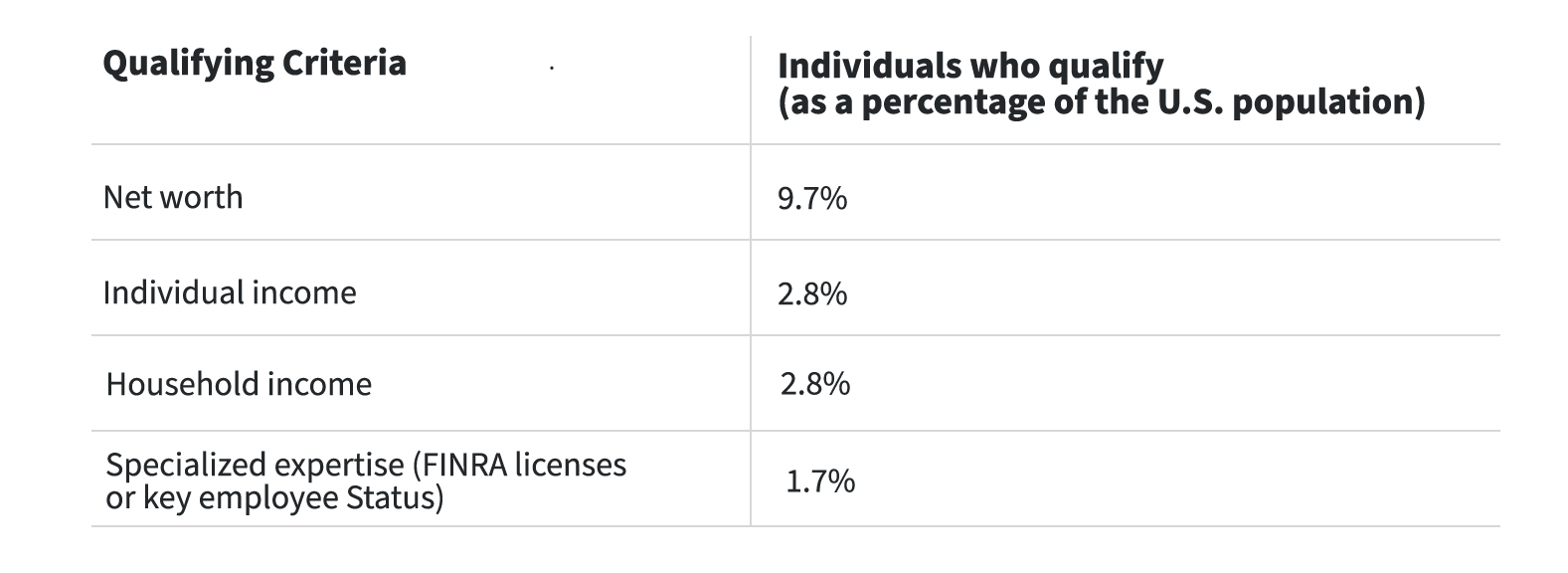
Table data: Exploring Accredited Investors and Private Market Securities Ownership. U.S. Securities and Exchange Commission. Office of the Investor Advocate. June 2025.
Benefits of being an accredited investor
Being an accredited investor allows you access to a wider range of investment opportunities, such as private real estate, that are historically uncorrelated with the public markets. If you are actively researching investment offerings and talking to alternative investment firms, you will find that many of these opportunities require you to be accredited for compliance purposes.
Specifically, accredited investors who allocate to opportunities like DLP Capital-sponsored funds can potentially establish a buffer against volatility, achieve greater portfolio diversification, and reduce overall risk exposure to market fluctuations.
Beyond diversification, private investments often offer tax benefits not typically available to public market investors. Investors in private real estate equity funds like the DLP Housing Fund can potentially shield or defer income from taxation through depreciation or the Qualified Business Income (QBI) deduction.5
As passive or limited partners, accredited investors do not need to take any extra steps to realize these benefits; these tax advantages are automatically passed through the fund to investors.
Beyond the investment itself, being an accredited investor with a private real estate firm like DLP Capital means access to educational opportunities, in-person events and experiences, lasting relationships, and white-glove service that’s lacking in the public markets. Far more than just an anonymous limited partner, you join an exclusive, intimate network of impact-driven families pursuing both success and significance.
Explore opportunities to invest on purpose with DLP Capital today. Learn more.