



If you’re a prospective private real estate investor venturing into multifamily from the stock market, there are plenty of industry terms that might sound unfamiliar.
From fund-level performance metrics like internal rates of return (IRRs) to deal-level metrics like cap rates, there can be a lot of new information to absorb.
As an accredited investor, you don’t have to be a financial expert to invest in private real estate. But understanding the basics, like what cap rates are and how they influence a property’s value, can help you better understand how your capital is invested and how investment decisions are made.
What is a cap rate?
A capitalization rate, commonly known as a cap rate, is defined as an income-producing property’s net operating income (NOI) divided by its current market value.1 Simply put, investors can use cap rates to determine a commercial real estate property’s value and income potential. This metric can also provide additional insight into how competitive the market is.
A property’s cap rate measures its potential return by comparing its income to its value. It’s also called the unlevered yield, showing what an investor would earn if they bought the property entirely with cash.
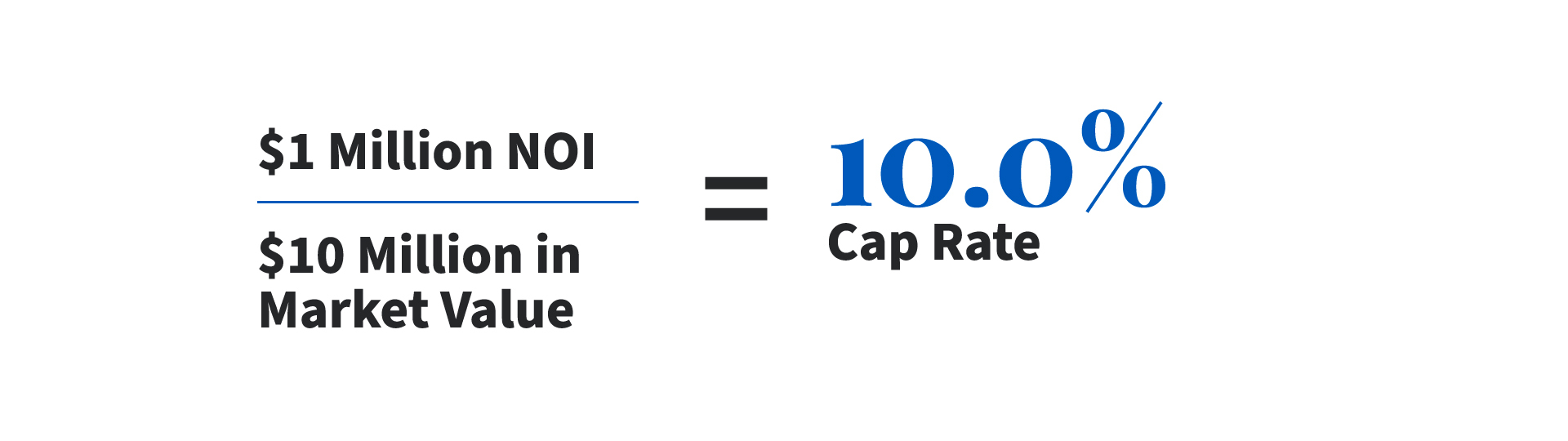
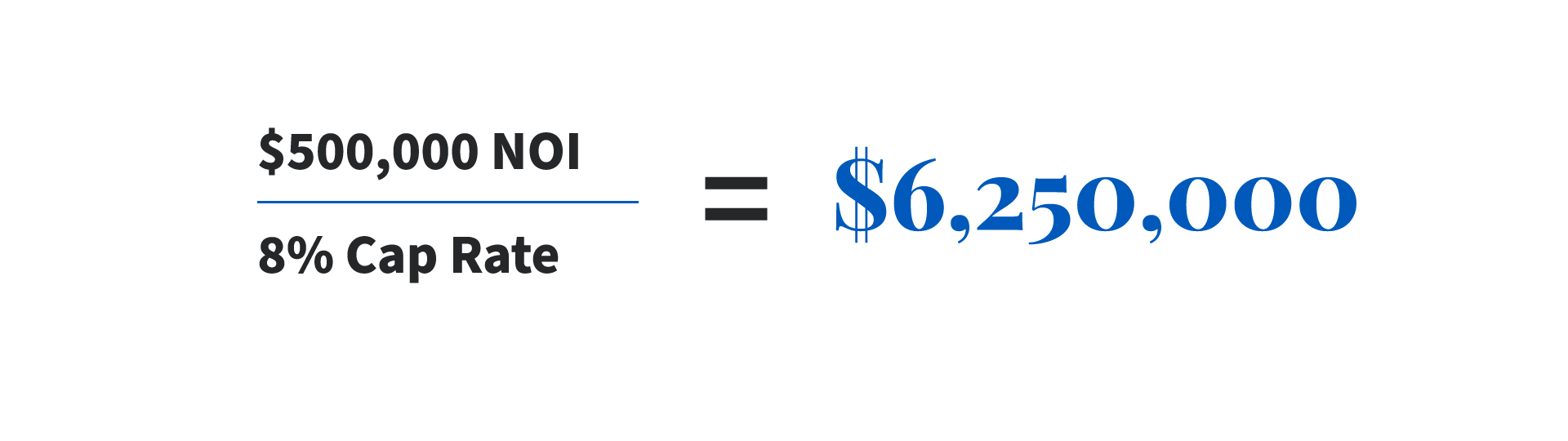
Reversing the equation can reveal additional insights. If you know the average cap rate in your market, you can use it to estimate a property’s approximate value. The formula is simple: divide the net operating income by the market cap rate to estimate a property's value.
On a qualitative level, cap rates indicate how risky the market perceives a property to be, with higher cap rates suggesting greater risk. To illustrate, suppose one multifamily complex trades at a 12% cap rate, while a different apartment community across town trades at a 3% cap rate.
Why are these two properties valued so differently? Common reasons include higher vacancy risk, tenant credit risk, deferred maintenance, or weaker market fundamentals. Mismanaged properties, or those located in a less desirable neighborhood, may likewise fetch lower valuations—higher cap rates.
In other cases, a low cap rate may indicate a very competitive market where buyers bid up assets, while a higher cap rate may indicate a less competitive market.
Cap rates are essential for accredited investors to understand when completing their due diligence process because they provide a snapshot of both a property’s risk and return potential. Although cap rates are a deal-level metric—meaning that investors in private real estate funds like the DLP Housing Fund are exposed to a diversified portfolio of properties at once, each with their own cap rate—they nonetheless provide important information about a fund’s holdings.
How do cap rates influence valuation?
As we mentioned above, cap rates and NOI both influence valuation. Changes in one or both variables at exit can impact an investment’s performance.
The table below illustrates how a hypothetical property’s valuation changes given its cap rate and NOI.2
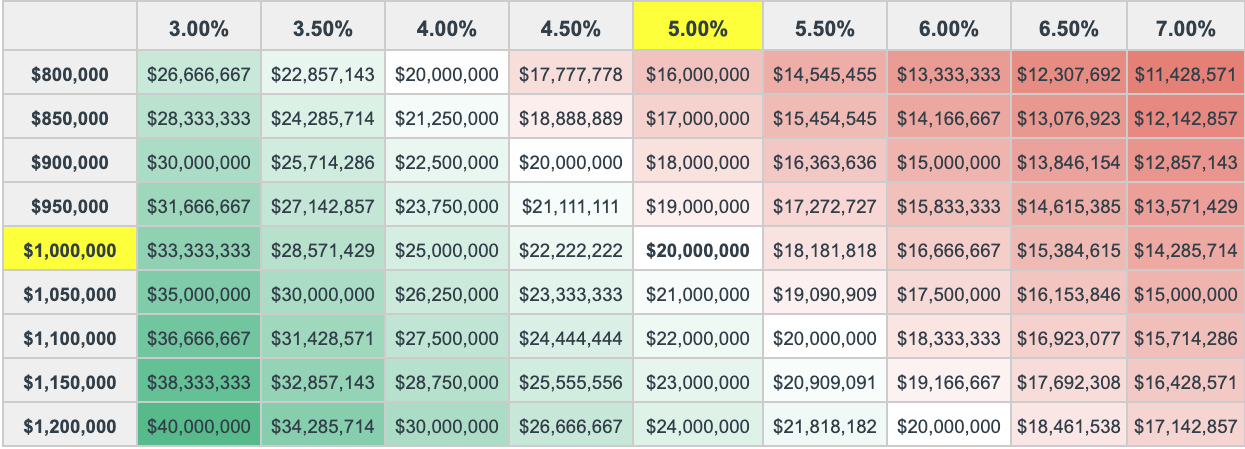
Suppose an investor acquires a property for $20 million. The property generated $1 million in NOI and traded at a 5% cap rate.
If the property’s cap rate were to expand to 6% while its NOI remains unchanged, its valuation would decline to $16.7 million.2 If cap rates instead compress to 4%, the property’s valuation—given the same NOI—would be $25 million.3
The takeaway for investors is that cap rates are inversely related to valuation. When cap rates rise, valuations fall. When cap rates fall, valuations rise.
Fund managers can create value for investors by buying at higher cap rates—lower valuations—and selling at lower cap rates, or higher valuations. This phenomenon is known as “cap rate compression,” and it allows fund managers to acquire assets at lower prices relative to their income streams and sell them for richer valuations relative to the same income stream.
How does NOI influence valuation?
Changes in NOI can also influence valuation. At a constant cap rate, higher NOI leads to higher valuations, while lower NOI results in lower valuations. This means that fund managers can likewise create value for investors by increasing the income a property generates.
Refer again to the table above. If the property’s NOI increases to $1,100,000, the property would be worth $22 million at a 5% cap rate.2 If NOI declines to $900,000, the property’s value would fall to $18 million.2
What is a “good” cap rate?
Because higher cap rates signal the potential for greater returns, accredited investors may assume that a higher number is always better. However, higher cap rates often come with higher levels of risk.
While an investment’s cap rate provides useful information, it rarely paints the full picture. Chasing the highest possible cap rate at the time of purchase can be a dangerous strategy if viewed in isolation. Rather, a cap rate must be considered alongside other asset-level risks, like location or repair risk.
For example, a multifamily property located in the outskirts of a slow-growing market may trade at a higher cap rate than an apartment community in a well-located part of a rapidly growing metropolitan area. Although the first property’s higher cap rate appears to make it more attractive, that number may reflect higher vacancy risk, weaker economic drivers, or the asset’s inability to fetch market rents.
Hidden repairs are another risk factor. While NOI—the number in the numerator of the cap rate formula—is stated net of operating expenses, it excludes major capital expenditure (CapEx) items, such as replacing roofs, HVAC systems, or parking lots. This means that a property’s actual cash flow may be lower than what its NOI, and therefore cap rate, suggests.
To illustrate, consider a 1970s-vintage apartment complex trading at a 10% cap rate. On paper, this looks superior to a brand-new community trading at 5%. However, if the older property has significant deferred maintenance, your cash flow may be consumed by repairs. In this light, you need that higher cap rate just to break even on a risk-adjusted basis if investing in an older, riskier asset.
Cap rates: A valuable quantitative and qualitative yardstick for investors
The math makes it clear that private real estate investors can benefit when fund managers acquire assets at higher cap rates and sell at lower ones.
But there’s more nuance to the “buy high, sell low” mantra than that.
While an asset with a high cap rate may look optically “cheap,” its cap rate could signal underlying problems, like a less-than-ideal location or the potential for unstable cash flows from tenant turnover. On the flip side, a luxury asset with a low cap rate may be a “safe” play, but its high price point relative to income limits the potential for yield.
One solution could be to look somewhere in the middle. By investing in attainable workforce housing through DLP Capital-sponsored funds, accredited investors can potentially optimize risk-adjusted returns by gaining exposure to multifamily assets that produce stable cash flows at reasonable prices.
Explore passive imultifamily real estate investment opportunities through DLP Capital-sponsored funds. Learn more today.